Showing posts with label audience. Show all posts

Tuesday, 29 January 2013

More Feedback


We presented our title sequence to the class and they gave us feedback on it which are the following:

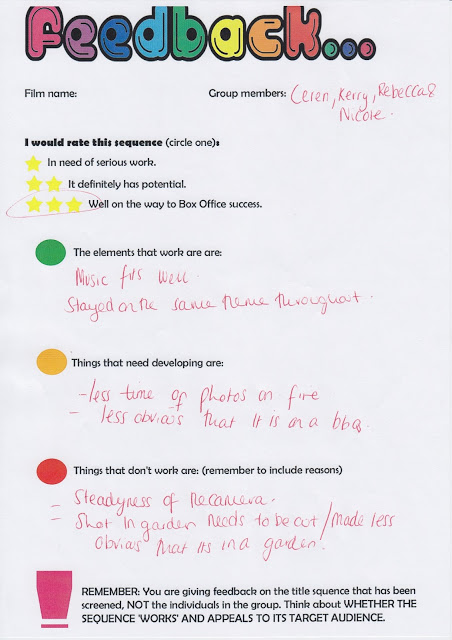

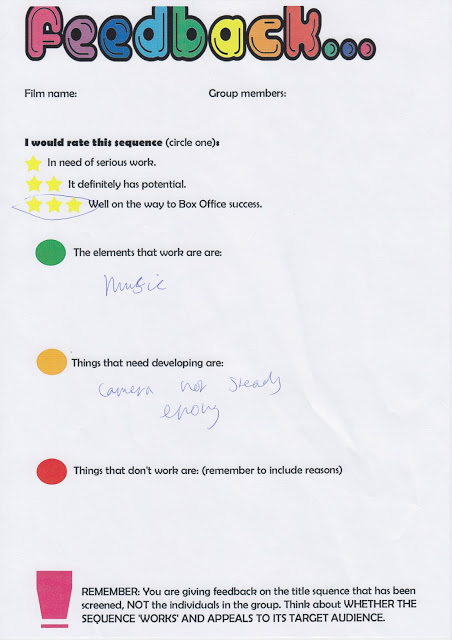

Overall, I think that the feedback was mostly positive as they pointed out the good parts and we got 3 stars from the majority. However, the negative points are fair as we agreed on some of them. For example, on more than one feedback sheet, the camera movement/shake/zooms are mentioned and we are aware of them and we tried to cover them up by teaching ourselves to overlap on final cut pro and put more effects on so they wouldn't seem as painful to watch. Our typography was also an issue as the class thought it was too blurry and not the right colour or position. We must also change what order our credits come up in and we need to fade out our foley sound better. We plan to make improvements wherever we can and hopefully when we next present our title sequence to the class, it'll be a complete success. 

Thursday, 22 November 2012

Class Notes: The Active Audience

The Active Audience

Effects Analysis - Hypodermic Needle Theory:

  • Developed in the 1920s.
  • The first theory to explain how mass audiences might react to mass media.
  • Information passes from media to audience unmediated.
  • The audience is passive - they have no say in process and accept everything at face value. 
Cultivation Theory:

  • While any one media text does not have too much effect, years and years of watching more violence will make you less sensitive to violence or years and years of watching women being mistreated in soaps will make you less bothered about it in real life. 
  • Difficult to prove as there is no way to measure exactly how much of an effect the media has on human behaviour.  
Two-Step Flow Model:

  • Whatever our experience of the media we will be likely to discuss it when others and if we respect their opinion, the chances are that we will be more likely to be affected by it. (The theory calls these people opinion leaders)
  • Considers the audience as a 'mass'.
 ACTIVE AUDIENCE

  • Different audiences can understand a media message but can have different responses to it. Some people believe and accept the message, others reject it using knowledge from their own experience or can use processes of logic or other rationales to criticize what is being said. 
Uses and Gratifications:
  • Blumler ans Katz believe that a ACTIVE AUDIENCE could consume a media product for the reasons below:
  • Diversion: A form of escapism or emotional release from everyday pressures. 
  • Personal relationships: companionship via television personalities and characters, and sociability through discussion about television with other people. 
  • Personal identity: the ability to compare one's own life with the characters and situations within programs and hence explore personal problems and perspectives. 
  • Surveillance: a regular supply of information about 'what's going on' in the world. 
  • Entertainment: sometimes we may just consume media for enjoyment. 
Reception analysis:
  • Concentrates on how an audience arrives at a media text.
  • Based on the idea that no text has one simple meaning - suggests that the audience themselves help to create the meaning of the text. 
  • We all decode the texts that we encounter in individual ways which may be a result of our upbringing, the mood that we are in, the place where we are at the time or in fact any combination of these an all kinda of other factors. 
  • Unlike Uses and Gratifications, which has areas of focus, Reception Theory is near-impossible to measure as it focuses upon the individual and takes into account the complexity of our response to the media. 
Audience theory:
Stuart Hall's encoding/decoding model of the relationship between text and audience.